
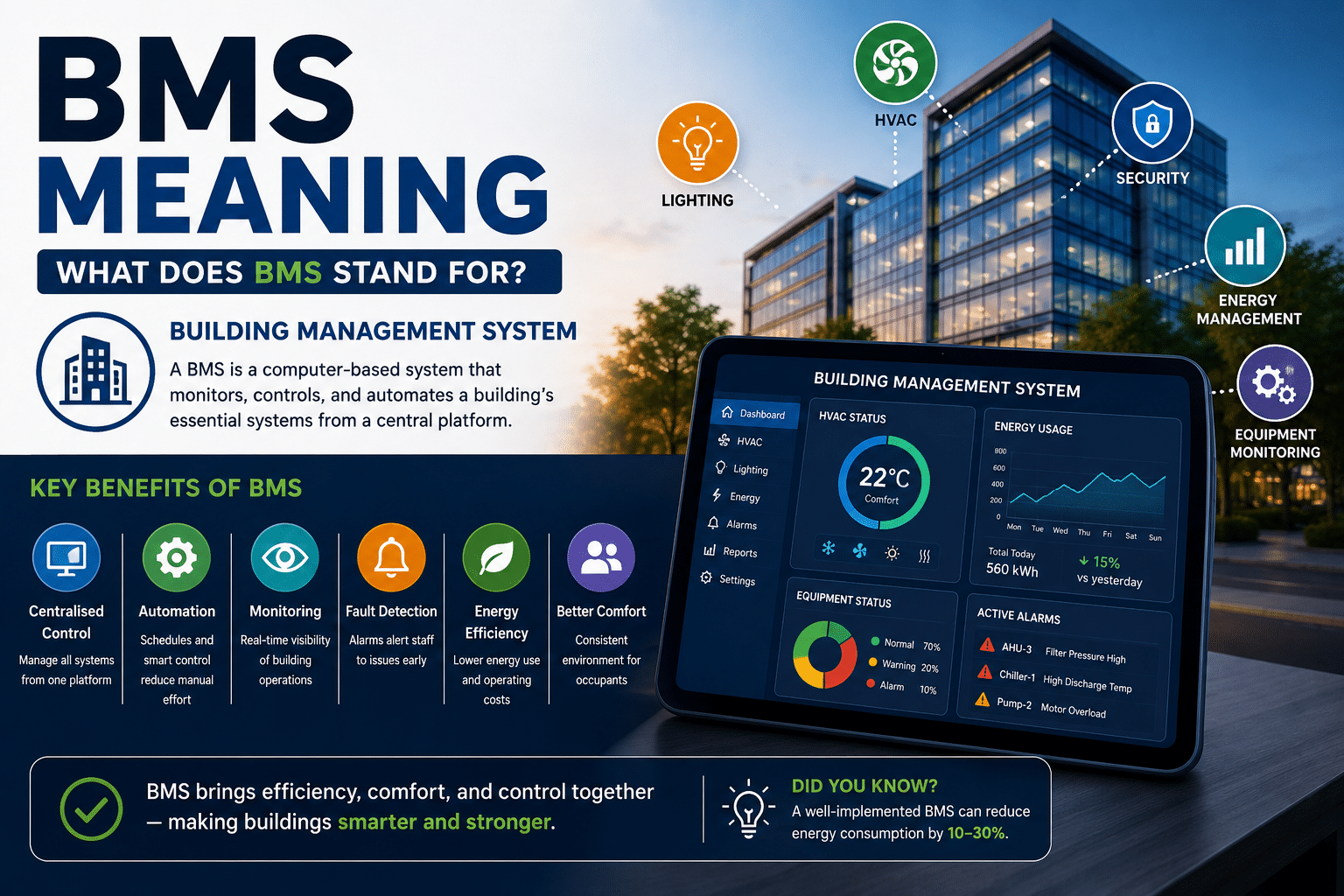
The BMS meaning most commonly searched in building, engineering, and facilities-management contexts is Building Management System. It is a computer-based system that monitors and controls important building services from a central platform. These services can include heating, ventilation, air conditioning (HVAC), lighting, energy systems, and other equipment.
A BMS helps building operators see what is happening across a facility, adjust equipment, respond to alarms, and automate routine operations. Government and industry sources describe it as a centralised approach to controlling building systems while supporting comfort and efficient operation.
However, BMS is not limited to buildings. In electric vehicles and energy storage, the same abbreviation can mean Battery Management System. Understanding the context is therefore essential.
What Is the BMS Meaning in Buildings?
In facilities management, BMS meaning Building Management System. It brings different mechanical and electrical systems together so they can be monitored and managed through a central interface.
Instead of checking individual systems separately, an operator can use the BMS to view equipment status, sensor readings, schedules, alarms, and other operational information in one place.
A typical system may monitor:
- Heating and cooling equipment
- Air-handling units
- Ventilation
- Lighting
- Pumps and fans
- Energy meters
- Temperature and humidity
- Equipment alarms
- Some access, safety, or security systems
The exact scope depends on the building and how the BMS has been designed. Modern systems can integrate multiple building services and collect information that helps operators identify abnormal conditions or inefficient operation.
How Does a Building Management System Work?
The basic process is straightforward: sensors collect information, controllers process it, and equipment responds to programmed instructions.
For example, temperature sensors can detect conditions inside different areas of a building. The BMS can compare those readings with programmed settings and adjust heating or cooling equipment accordingly.
A typical setup contains three practical layers:
- Sensors and field devices – These measure conditions such as temperature, pressure, humidity, occupancy, or equipment status.
- Controllers – These process information and execute programmed control logic.
- Supervisory software – This provides the central interface where operators can monitor equipment, change settings, review trends, and respond to alarms.
Communication protocols allow different devices and systems to exchange information. Depending on the installation, technologies such as BACnet, Modbus, or other building-automation protocols may be used.
This architecture means a BMS is more than a dashboard. It can actively control connected equipment according to schedules, sensor readings, operating conditions, and predefined rules.
What Can a BMS Control?
The answer depends on the installation, but HVAC is usually one of the most important areas.
A BMS may control or monitor chillers, boilers, air-handling units, heat pumps, fans, pumps, lighting, and energy meters. Larger facilities can also integrate other systems, although safety-critical equipment may have separate dedicated controls.
For example, an office building could use scheduled operation to reduce unnecessary heating or cooling when the building is unoccupied. An operator could also receive an alarm if equipment operates outside an expected range.
This combination of automation and monitoring is one reason the BMS meaning is closely associated with building efficiency and facility operations.
Why Are Building Management Systems Important?
The main value of a BMS is centralised visibility and control.
Without an integrated system, facility teams may need to check several independent controls and equipment interfaces. A BMS can bring relevant information together, making it easier to identify problems and respond to changing conditions.
Key advantages include:
| Benefit | How It Helps |
|---|---|
| Centralised control | Operators can manage connected systems from one interface |
| Automation | Equipment can follow schedules and programmed conditions |
| Monitoring | Sensor and equipment information can be viewed continuously |
| Fault detection | Alarms can alert staff to abnormal conditions |
| Energy management | Operating data can help identify unnecessary consumption |
| Occupant comfort | Heating, cooling, and ventilation can be managed more consistently |
A BMS can therefore support both day-to-day operations and longer-term maintenance decisions. It can also store operational data, allowing facility teams to examine trends instead of relying solely on manual observations.
💡 Pro Tip: When evaluating a BMS, do not focus only on the appearance of its dashboard. Check which systems it can integrate, what data it records, which communication protocols it supports, and how easily operators can respond to alarms.
BMS vs BAS: Are They the Same?
You may also encounter BAS, which stands for Building Automation System.
In many situations, BMS and BAS refer to broadly similar building-control technology. The terminology can vary between regions, manufacturers, engineers, and project specifications. Schneider Electric, for example, describes BMS as a system that allows users to control major building systems through one platform and also identifies BAS as a related term.
Some organisations use BMS to emphasise overall building management and supervisory functions, while BAS may emphasise automation and control. In practical discussions, however, the two terms are often used interchangeably.
Another related term is BEMS, or Building Energy Management System. This generally puts greater emphasis on energy monitoring, analysis, and optimisation.
BMS Meaning in Batteries
The phrase has another important meaning outside building management.
In electric vehicles, battery storage, and rechargeable battery systems, BMS can mean Battery Management System. This is electronic control technology designed to monitor and manage battery operation.
A battery BMS can monitor factors such as cell voltage, current, and temperature. Depending on the design, it can also support functions such as cell balancing, protection, state estimation, and communication with other equipment. Honeywell, for example, describes battery-management technology for energy-storage applications as providing monitoring, protection, communication, and energy-management capabilities.
The two meanings are completely different:
| BMS Expansion | Industry | Main Purpose |
|---|---|---|
| Building Management System | Buildings and facilities | Monitor and control building services |
| Battery Management System | EVs and energy storage | Monitor, protect, and manage batteries |
So, if someone asks for the BMS meaning while discussing HVAC, facilities, or commercial property, they are almost certainly referring to Building Management System. If the conversation involves lithium-ion batteries, electric vehicles, or energy storage, Battery Management System is the more likely interpretation.
📌 Key Takeaway: The BMS meaning depends on context, but in facilities management it normally means Building Management System. A building BMS connects monitoring, automation, alarms, and control functions to help operators manage a facility more effectively.
Common Uses of BMS Technology
Building management systems are particularly useful in large or complex facilities where many systems need to operate together.
Common environments include:
- Office buildings
- Hospitals and healthcare facilities
- Universities and schools
- Hotels
- Shopping centres
- Industrial facilities
- Data centres
- Large residential developments
A small building may have only basic automation, while a large facility may have thousands of data points and extensive integrations.
The goal is not necessarily to automate everything. A well-designed BMS should give operators useful information and reliable control without making everyday management unnecessarily complicated.
Frequently Asked Questions
What does BMS stand for?
In building and facilities-management contexts, BMS stands for Building Management System. It is a computer-based system used to monitor and control building services such as HVAC, lighting, energy systems, and related equipment. In battery technology, however, BMS can mean Battery Management System.
Is BMS the same as BAS?
BMS and BAS are often used to describe similar building automation and control systems. The terminology varies by industry and region. BMS commonly emphasises broader building management and supervisory functions, while BAS often highlights automation and control. The actual capabilities depend on the system installed.
What does a BMS control?
A building BMS can monitor and control systems such as heating, cooling, ventilation, air-handling equipment, pumps, fans, lighting, and energy meters. Some installations also integrate access, security, safety, or other building systems. The precise scope depends on the facility’s design and integration requirements.
Is BMS only used in large buildings?
No. BMS technology can be used in buildings of different sizes, although it becomes particularly valuable when a facility has many interconnected systems. Large commercial, healthcare, educational, industrial, and institutional buildings often benefit from centralised monitoring and automation.
What is the BMS meaning in an electric vehicle?
In an electric vehicle, BMS usually means Battery Management System, not Building Management System. It monitors and helps protect the vehicle’s battery pack by managing factors such as voltage, current, temperature, and battery operating conditions. Its purpose is fundamentally different from building automation.
Conclusion
The BMS meaning is usually Building Management System when the subject is commercial buildings, HVAC, facilities, or building automation. It provides a central way to monitor equipment, automate operations, manage alarms, and understand building performance.
The same abbreviation can also mean Battery Management System in electric vehicles and energy storage, so context matters. Knowing which meaning applies makes technical discussions, product research, and search results much easier to understand.
For building professionals, the most useful way to think about a BMS is as the central supervisory layer that connects information and control across a facility. When properly designed and maintained, it can help operators make better decisions while keeping building systems responsive and manageable.
