
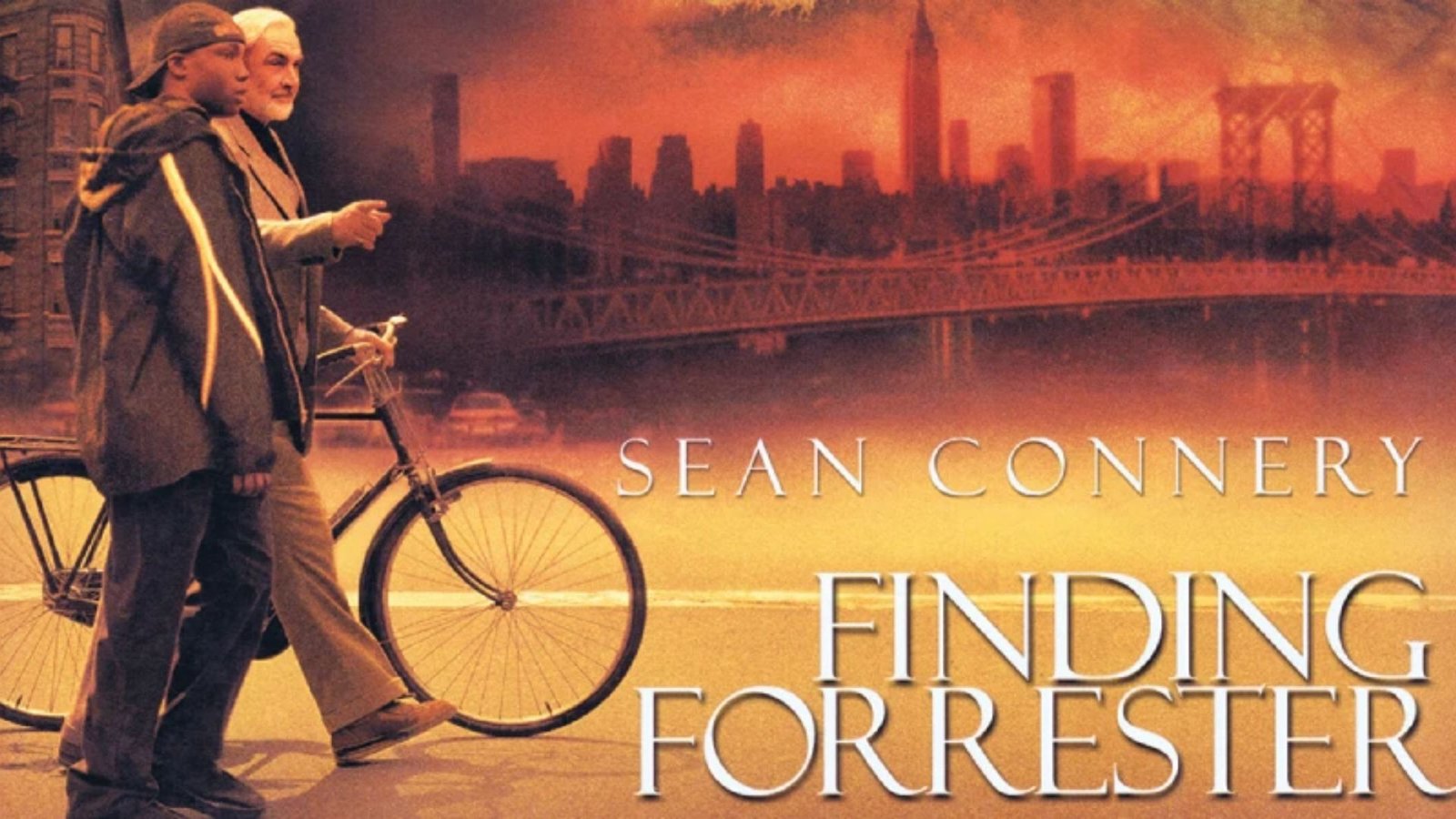
Some movies about writing are really about something else: confidence, opportunity, identity, or the person who finally sees potential in you before you see it yourself. Finding Forrester works because it combines all of those ideas without making writing feel like a distant academic subject.
Released in 2000 and directed by Gus Van Sant, the drama follows Jamal Wallace, a talented teenager from the Bronx whose ability on the basketball court attracts attention at an elite private school. His life changes when he develops an unexpected friendship with William Forrester, a reclusive Pulitzer Prize-winning novelist played by Sean Connery. Forrester recognizes that Jamal has a serious talent for writing and begins mentoring him.
But the movie is not simply about an older writer teaching a younger one. It is about assumptions: what teachers expect from students, what schools expect from athletes, and what people assume someone from a particular neighborhood can achieve.
That makes the film particularly interesting for viewers who want more than a conventional coming-of-age story.
What Is Finding Forrester About?
At its core, Finding Forrester is a coming-of-age drama about two people who are both trapped by other people’s expectations.
Jamal Wallace is a gifted student and basketball player. Although his school performance does not initially reveal his full academic ability, standardized testing catches the attention of a prestigious Manhattan prep school. The school is interested partly because of his basketball talent, but Jamal soon demonstrates that his intellectual abilities extend far beyond sports.
William Forrester lives almost completely apart from the world around him. He became famous after publishing a successful novel but has spent years as a recluse.
Their meeting creates an unusual exchange. Forrester helps Jamal develop as a writer, while Jamal gradually pushes Forrester to confront the isolation that has defined his life.
The relationship therefore works in both directions. The obvious story is about a mentor helping a student. The deeper story is about two people helping each other change.
Finding Forrester Cast and Characters
The cast gives the film much of its emotional weight.
| Actor | Character | Role in the story |
|---|---|---|
| Sean Connery | William Forrester | Reclusive novelist and Jamal’s mentor |
| Rob Brown | Jamal Wallace | Gifted student, writer and basketball player |
| F. Murray Abraham | Professor Crawford | Jamal’s demanding literature teacher |
| Anna Paquin | Claire Spence | Jamal’s friend and classmate |
| Busta Rhymes | Terrell Wallace | Jamal’s older brother and supporter |
| Michael Pitt | John Coleridge | Jamal’s classmate |
Sean Connery plays William Forrester with a mixture of toughness, humor and vulnerability. Rob Brown, making his major film debut, carries much of the story as Jamal. The supporting cast includes F. Murray Abraham, Anna Paquin, Busta Rhymes and Michael Pitt.
One especially interesting casting detail is Rob Brown’s position opposite an established actor such as Connery. The film depends on their relationship feeling believable, and much of the story’s effectiveness comes from the contrast between Forrester’s experience and Jamal’s youth.
Brown’s performance also received recognition during the film’s awards season. He won Best Newcomer from the Las Vegas Film Critics Society and received additional nominations and awards attention for his performance.
The Relationship Between Jamal and Forrester
The heart of the film is not the classroom or basketball court. It is the evolving relationship between Jamal and Forrester.
Their first interactions are uncomfortable. Jamal is curious about the mysterious man watching the neighborhood from his apartment, while Forrester initially wants to remain isolated.
Once Forrester discovers Jamal’s writing ability, however, the relationship changes.
Forrester teaches Jamal that good writing requires more than having something interesting to say. It requires discipline, revision and confidence. At the same time, Jamal’s presence gives Forrester a reason to interact with someone outside the carefully controlled world he has created.
This creates one of the film’s strongest ideas:
A mentor does not always teach from a position of complete wisdom. Sometimes the student changes the mentor just as much.
That distinction is easy to miss if the movie is viewed only as an inspirational school drama.
Why Writing Matters So Much in the Film
Writing is used as a way of measuring identity.
Jamal is already intelligent, but he does not always receive recognition for that intelligence. His basketball talent is immediately visible, while his writing ability is something he has kept largely private.
That contrast creates a practical point that remains relevant outside the movie: people often receive opportunities based on the ability others can easily see.
A student may be excellent at mathematics but be known primarily for music. Another might be a talented writer but be recognized mainly as an athlete. The film asks what happens when one visible talent causes everyone to overlook another.
Forrester’s mentoring therefore becomes about more than improving sentences. He helps Jamal understand that he does not have to choose the identity other people have assigned to him.
The Film’s View of Education
The private-school setting introduces another important conflict.
Jamal enters an environment where academic standards are high, but not every adult treats him with the same respect. Professor Crawford, played by F. Murray Abraham, becomes particularly important because he represents an authority figure who doubts Jamal’s abilities.
The conflict is partly about academic integrity, but it also involves assumptions about who is capable of producing sophisticated work.
Roger Ebert’s contemporary review highlighted this aspect of the story, noting the tension surrounding Jamal’s ability to succeed academically while also being a successful basketball player.
The film does not present education as automatically fair simply because the school is prestigious. Instead, it shows how institutional opportunity and personal prejudice can exist at the same time.
Finding Forrester and the “Good Will Hunting” Comparison
One reason the film sometimes gets compared with Good Will Hunting is its basic dramatic structure.
Both stories feature a young person with exceptional intellectual ability and an older mentor who helps that talent emerge. Both also explore education, self-doubt and the difficulty of living up to expectations.
However, the settings and relationships are different.
Good Will Hunting centers heavily on mathematics, psychology and working-class Boston. Finding Forrester places writing and basketball at the center of its story and builds its relationship around an older writer and a teenage athlete.
The comparison is worth knowing because contemporary critical reception also identified similarities between the two films. Rotten Tomatoes’ consensus describes Finding Forrester as somewhat predictable while praising the relationship between Connery and Brown.
Three Details That Are Easy to Miss
1. Forrester was not simply created as a generic fictional writer
The character has often been associated with J. D. Salinger because of his reclusive lifestyle and the parallels between a famous author withdrawing from public life and Forrester’s fictional existence.
The film itself is not a biography of Salinger, and Forrester is a fictional character. However, Connery later acknowledged Salinger as an inspiration for his portrayal.
That connection adds another layer to Forrester’s character. His isolation is not merely a quirky personality trait; it reflects the film’s interest in what fame and creative success can cost.
2. The mentor-student relationship is deliberately reciprocal
A common reading of the movie is that Forrester saves Jamal from self-doubt.
That is only half the story.
Jamal also forces Forrester back toward life. The younger character is not simply a blank page waiting for an older expert to fill it with wisdom. His energy, curiosity and willingness to challenge Forrester become part of Forrester’s own transformation.
This makes the relationship more interesting than a conventional “wise teacher helps gifted student” formula.
READ ALSO :The Last Dance: Jordan Documentary vs. Venom
3. Music quietly reinforces the film’s atmosphere
The soundtrack uses jazz-related material, including music associated with Miles Davis, while Bill Frisell contributed original music. The musical choices complement the movie’s focus on writing, solitude and New York City without turning every emotional moment into an obvious musical cue.
That understated approach is easy to overlook, but it contributes to the film’s distinctive atmosphere.
What Makes Jamal’s Story Different From a Typical Sports Drama?
Basketball is central to Jamal’s identity, but the movie does not treat it as the final destination.
That is an important distinction.
In many sports dramas, the protagonist’s central question is whether they will succeed on the court. Jamal’s problem is more complicated because he has multiple abilities and multiple possible futures.
He can write.
He can play basketball.
He can perform academically.
He also has to decide how much of himself he is willing to reveal in environments where people have already formed opinions about him.
The basketball court therefore becomes a symbol of the identity that other people understand most easily. Writing represents another part of Jamal that requires people to look more closely.
Is Finding Forrester Based on a True Story?
No. Finding Forrester is not a true-story biographical film.
It was written by Mike Rich and directed by Gus Van Sant. The story and its principal characters are fictional, although William Forrester has been associated with J. D. Salinger as an inspiration for the character.
This distinction matters because the film’s realistic educational and social conflicts can make the story feel autobiographical.
It is better understood as a fictional drama built around recognizable real-world experiences: academic pressure, racial assumptions, mentorship, adolescent identity and creative ambition.
Finding Forrester Reception and Legacy
The movie was released in December 2000 and runs for roughly two hours and fifteen minutes, depending on the listed version. Sony Pictures identifies it as a drama, while the AFI Catalog lists it as a comedy-drama.
It received generally positive critical attention. Rotten Tomatoes currently lists a 74% Tomatometer score and places the film among its entries for notable movies released in 2000. IMDb lists a 7.3/10 user rating from roughly 96,000 ratings at the time of its current listing.
The movie also earned several awards and nominations. Rob Brown’s performance was particularly recognized, while Mike Rich received attention for his first screenplay.
Its lasting appeal is less about plot originality than execution. The basic premise is familiar, but the combination of literature, basketball, race, education and an unlikely friendship gives it a recognizable identity.
Common Misunderstandings About the Movie
A few assumptions can make the film seem simpler than it really is.
It is not primarily a basketball movie. Basketball gets Jamal noticed, but writing drives his personal development.
Forrester is not simply a perfect mentor. He has his own emotional limitations and unresolved past.
Jamal is not simply an underachieving student. His standardized-test performance demonstrates that his abilities were considerably greater than his ordinary grades suggested.
The school conflict is not only about plagiarism or academic rules. It also raises questions about trust, privilege and whether authority figures judge students consistently.
These distinctions make a second viewing more rewarding because details that initially seem like plot devices become part of the film’s larger argument.
What Can Viewers Take From Finding Forrester?
The film offers several practical lessons that apply beyond school and writing.
Talent needs an environment where it can develop
Being talented is not always enough. Access to encouragement, criticism, resources and someone willing to recognize potential can make a significant difference.
A visible skill can hide a deeper ability
Jamal’s basketball talent makes him easy for others to categorize. His writing forces people to reconsider that first impression.
Good mentorship is a two-way relationship
The best mentor relationships are not necessarily about one person having all the answers. Both people can learn, challenge each other and change.
Confidence and competence are different
Jamal has genuine ability before he becomes fully confident in expressing it. The film separates having talent from being comfortable claiming it.
Frequently Asked Questions
Is Finding Forrester worth watching?
For viewers interested in coming-of-age dramas, mentorship, writing or education, the film offers several layers beyond its basic plot. Its central relationship between Jamal and Forrester is the main reason the story continues to attract attention. The film also combines basketball and literature in a way that gives the protagonist competing identities.
Who plays Forrester in Finding Forrester?
Sean Connery plays William Forrester, the reclusive novelist who becomes Jamal Wallace’s mentor. Rob Brown plays Jamal. F. Murray Abraham, Anna Paquin and Busta Rhymes appear in major supporting roles.
Is Finding Forrester based on J. D. Salinger?
The film is not a biography of J. D. Salinger. William Forrester is a fictional character, although Salinger’s reclusive public image has been identified as an inspiration for the character, and Connery acknowledged that connection.
What is the main message of Finding Forrester?
The movie explores the importance of recognizing talent beyond stereotypes and giving people room to define themselves. It also presents mentorship as a relationship in which both the student and mentor can grow. Jamal’s story ultimately becomes as much about identity and self-confidence as it is about writing.
Who directed Finding Forrester?
Gus Van Sant directed the film, with Mike Rich writing the screenplay. Sean Connery, Rob Brown, F. Murray Abraham and Anna Paquin lead the principal cast.
Conclusion
Finding Forrester remains an engaging drama because its central conflict is bigger than writing or basketball. Jamal wants to be recognized for the person he actually is rather than the version of him that other people find easiest to understand.
Forrester, meanwhile, begins the story believing isolation is the safest way to live. His friendship with Jamal gradually challenges that decision.
The result is a film about talent, mentorship, prejudice, education and second chances. Its most valuable idea may be the simplest one: discovering someone’s ability is only the beginning. The more difficult task is giving that person enough trust and freedom to use it.
