
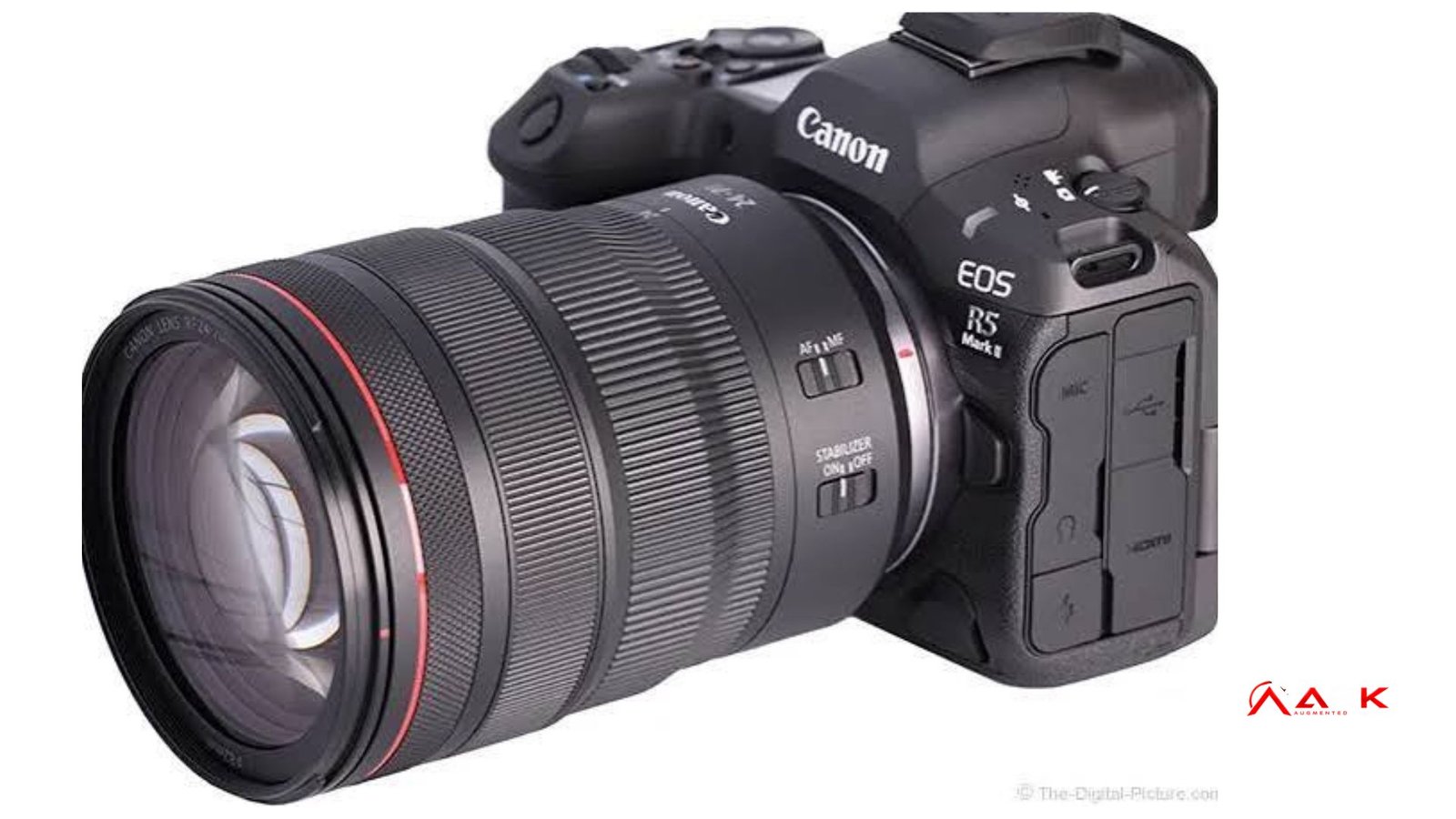
The Canon EOS R5 Mark II is a high-resolution full-frame mirrorless camera designed for photographers and filmmakers who need speed without giving up detail. Its 45-megapixel stacked sensor, advanced autofocus, 30fps electronic-shutter shooting, and extensive 8K video capabilities make it one of Canon’s most versatile enthusiast and professional bodies.
The bigger story is not simply resolution. Canon redesigned the sensor architecture and added the DIGIC Accelerator alongside DIGIC X, allowing the camera to process large amounts of image data quickly. That gives the R5 II a stronger focus on action, hybrid shooting, and demanding video workflows.
What makes the Canon EOS R5 Mark II different?
The biggest hardware change is the move to a back-illuminated stacked 45MP full-frame CMOS sensor. Stacked architecture allows faster readout than the conventional sensor in the original EOS R5, which helps reduce rolling-shutter distortion and enables much faster electronic-shutter shooting.
The camera can capture 14-bit RAW images electronically at up to 30 frames per second, while still offering mechanical-shutter shooting for situations where that makes more sense. Canon also introduced improved subject detection and tracking, Eye Control AF, and processing designed to recognize subjects and their movement more intelligently.
For photographers, that combination makes the Canon EOS R5 Mark II particularly interesting for sports, wildlife, events, weddings, and other situations where subjects move unpredictably.
Key specifications
| Feature | Canon EOS R5 Mark II |
|---|---|
| Sensor | 45MP full-frame stacked CMOS |
| Mount | Canon RF |
| Electronic burst | Up to 30fps |
| Video | Up to 8K/60p RAW |
| Stabilization | In-body image stabilization |
| Viewfinder | 5.76-million-dot EVF |
| Storage | CFexpress Type B + UHS-II SD |
| Weight | Approx. 746g |
Canon lists support for CFexpress Type B and UHS-II SD cards, while the RF mount also allows compatible EF and EF-S lenses when used with Canon’s EF-EOS R adapter.
Autofocus and action performance
Autofocus is one of the strongest reasons to consider the Canon EOS R5 Mark II over its predecessor. The camera uses Canon’s Dual Pixel Intelligent AF system with subject detection and tracking features supported by the DIGIC Accelerator. It can identify people and other subjects while using detailed information about body, head, and joint positions to improve tracking.
Eye Control AF is another distinctive feature. Instead of relying entirely on buttons or the touchscreen to select an autofocus subject, the system allows the photographer to direct the focus area using eye movement through the electronic viewfinder.
Canon has also introduced specialized Action Priority autofocus modes for certain sports. These are useful when the camera needs to understand the context of an action rather than simply track the nearest moving object. Independent testing found the autofocus system fast and effective, although Eye Control performance may not suit every photographer.
💡 Pro Tip: For sports and wildlife, test your preferred AF subject-detection mode before an important shoot. The most sophisticated setting is not automatically the best choice for every background, subject, or lighting condition.
Video capabilities are a major upgrade
The Canon EOS R5 Mark II is also built for serious hybrid creators. It can internally record 8K RAW video at up to 60 frames per second, while offering additional 4K recording options, Canon Log 2, waveform monitoring, false color, and other tools that make exposure control more practical for professional video work.
The stacked sensor also helps reduce rolling shutter compared with the original R5. For filmmakers shooting fast movement, that can make footage look more natural.
However, high-resolution video creates substantial heat and storage demands. Independent testing found that the most demanding 8K modes are better suited to shorter takes than uninterrupted long-form recording. Canon offers the optional CF-R20EP cooling fan grip for users who need additional thermal support.
That distinction matters. The Canon EOS R5 Mark II can function as a powerful video camera, but it is still a compact hybrid body rather than a dedicated cinema camera.
Image quality and everyday handling
With 45MP resolution, the R5 II provides substantial cropping flexibility and enough detail for large prints. The full-frame sensor also gives photographers the familiar depth-of-field and low-light advantages associated with full-frame systems.
In-body stabilization works with compatible lenses to provide coordinated stabilization, helping handheld photographers use slower shutter speeds when the subject itself is stationary.
The body weighs approximately 746 grams with battery and card, according to published specifications. That is reasonable for a professional-level full-frame hybrid, although photographers prioritizing minimal travel weight may prefer a smaller body.
One useful change for video users is the inclusion of professional exposure-monitoring tools. Waveform and false-color displays can make judging exposure easier, particularly when working with log footage.
Canon EOS R5 Mark II vs. the original R5
The original EOS R5 remains a capable 45MP camera, so upgrading depends heavily on how you shoot. The Mark II brings its most meaningful improvements to speed, autofocus, electronic-shutter performance, and video functionality.
For landscape, studio, and slower-paced photography, the original R5 may still provide enough capability. For sports, wildlife, action, and hybrid video work, the newer body offers more substantial advantages. DPReview similarly found the upgrade case stronger for action and video shooters than for photographers whose needs have not changed.
Another consideration is cost. Canon launched the R5 II at a recommended U.S. body-only price of $4,299, placing it firmly in the high-end full-frame mirrorless market. Current retail pricing can vary, so buyers should check today’s price rather than relying on the launch figure.
📌 Key Takeaway: The Canon EOS R5 Mark II is best viewed as a high-performance hybrid camera rather than simply a higher-resolution R5. Its strongest advantages are speed, autofocus, action shooting, and advanced video tools.
Frequently Asked Questions
Is the Canon EOS R5 Mark II good for professional photography?
Yes. Its 45MP sensor, fast electronic shooting, advanced subject tracking, stabilization, and extensive RF lens selection make it suitable for professional sports, wildlife, wedding, commercial, portrait, and editorial photography. The ideal choice still depends on the photographer’s workflow, lens requirements, and need for specialized features.
Does the R5 Mark II shoot 8K video?
Yes. The camera supports internal 8K RAW recording at up to 60p. It also offers several 4K modes, including high-frame-rate options. The demanding nature of 8K recording means heat management, fast storage, and appropriate shooting durations should be considered.
Is the R5 Mark II better than the original R5?
For many action and video users, yes. The Mark II adds a stacked sensor, faster electronic shooting, improved autofocus, Eye Control AF, and expanded video tools. For photographers primarily shooting landscapes or static subjects, the original R5 can remain a capable and potentially more economical option.
Does the R5 Mark II have built-in GPS?
No. GPS positioning is handled through a smartphone connection or an external GPS accessory rather than an integrated GPS receiver.
What lenses work with the R5 Mark II?
The camera uses Canon’s RF mount and supports Canon RF and RF-S lenses. Compatible EF and EF-S lenses can also be used with the EF-EOS R mount adapter. EF-M lenses are not supported.
Final Verdict
The Canon EOS R5 Mark II is a substantial evolution of Canon’s high-resolution hybrid platform. Its 45MP stacked sensor provides both detail and speed, while sophisticated autofocus makes it considerably more attractive for unpredictable subjects. Its 8K RAW recording and cinema-oriented monitoring tools also give serious creators a broader production toolkit.
For photographers who mainly capture static subjects, the original R5 can still make sense. But for action, wildlife, professional events, and demanding hybrid workflows, the Canon EOS R5 Mark II offers a more capable balance of resolution, speed, autofocus, and video performance.
